

project:region:instance, which is on the instance’s overview page in the Google Cloud console. The proxy itself runs as a child process, started on connect and killed on disconnect.
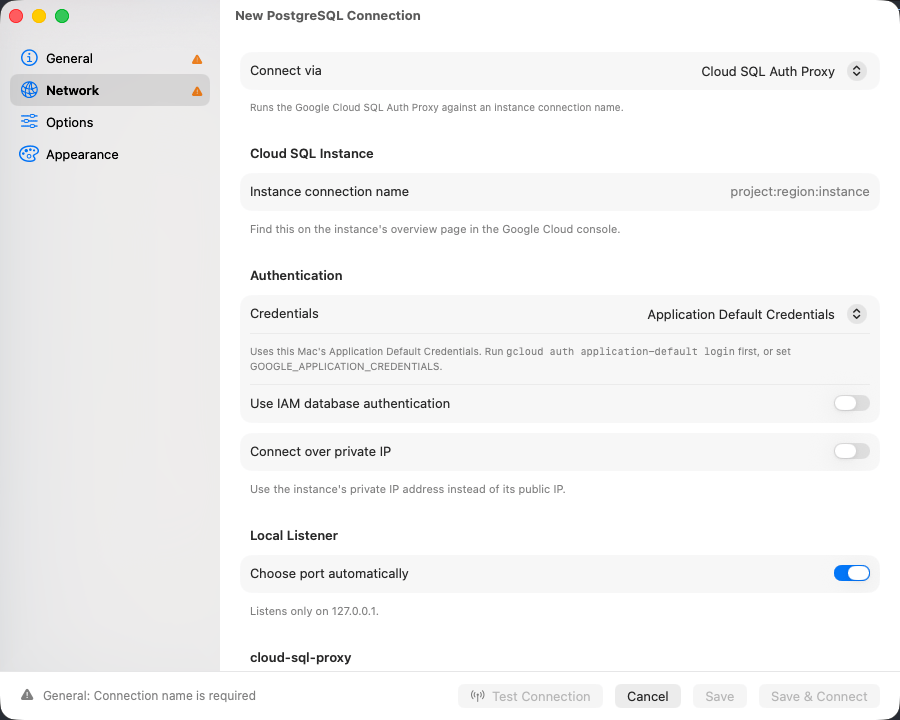
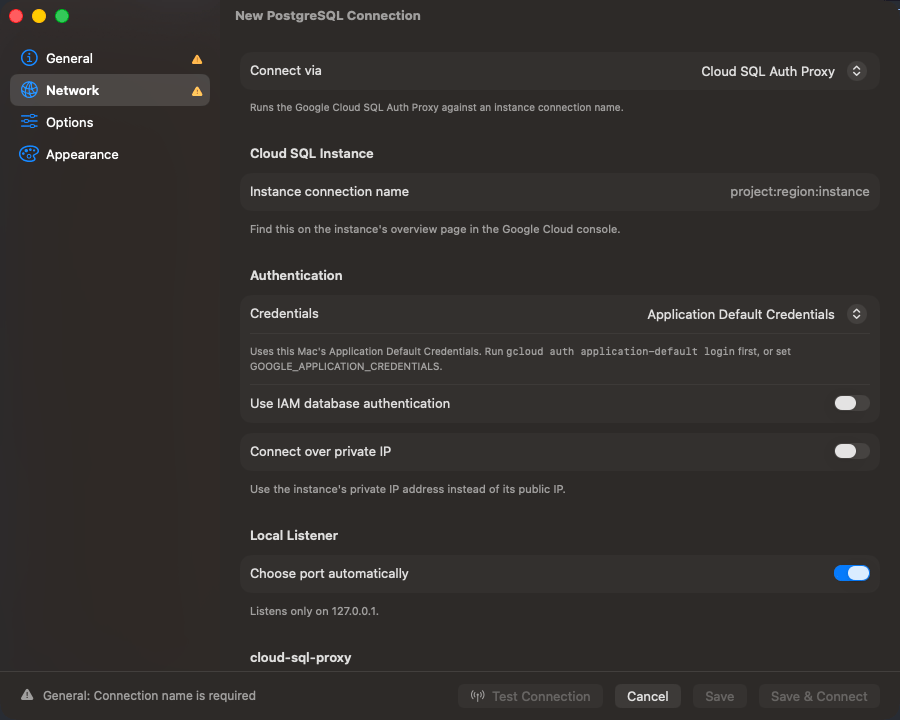
Cloud SQL Auth Proxy selected on the Network tab
Before you start
The pane appears for Cloud SQL instances running MySQL, PostgreSQL, or SQL Server. The account you connect with needs the Cloud SQL Client role (roles/cloudsql.client) on the project, and for Application Default Credentials, one run of:
PATH, /opt/homebrew/bin, /usr/local/bin, and ~/google-cloud-sdk/bin. Anywhere else, use Choose….
Setting up
1
Enable the pane
On the Network tab, set Connect via to Cloud SQL Auth Proxy. A connection uses one transport, so choosing this one switches off whichever was selected before.
2
Name the instance and pick credentials
Enter the Instance connection name, then choose Application Default Credentials or Service Account Key.
3
Leave the SSL pane alone
The proxy encrypts the leg to Cloud SQL and hands the driver plain loopback, so SSL/TLS stays off.
4
Test it
On General, click Test Connection. Host and Port there are never dialed: the instance connection name decides where the proxy lands. Username and Database work as usual.
Options
A pasted key is kept in the macOS Keychain and written to a temporary file readable only by you while the proxy runs, then deleted. It never reaches the command line.
GOOGLE_APPLICATION_CREDENTIALS works too, but the proxy inherits the app’s environment, and a GUI app never sees variables exported by your shell profile.
TablePro polls that port and gives 30 seconds to answer on it. Past that the connect fails
and the error carries the last lines printed, which is where the real reason usually is.
Troubleshooting
cloud-sql-proxy was not found
Install it withbrew install cloud-sql-proxy, download it from the pane, or set Path.